

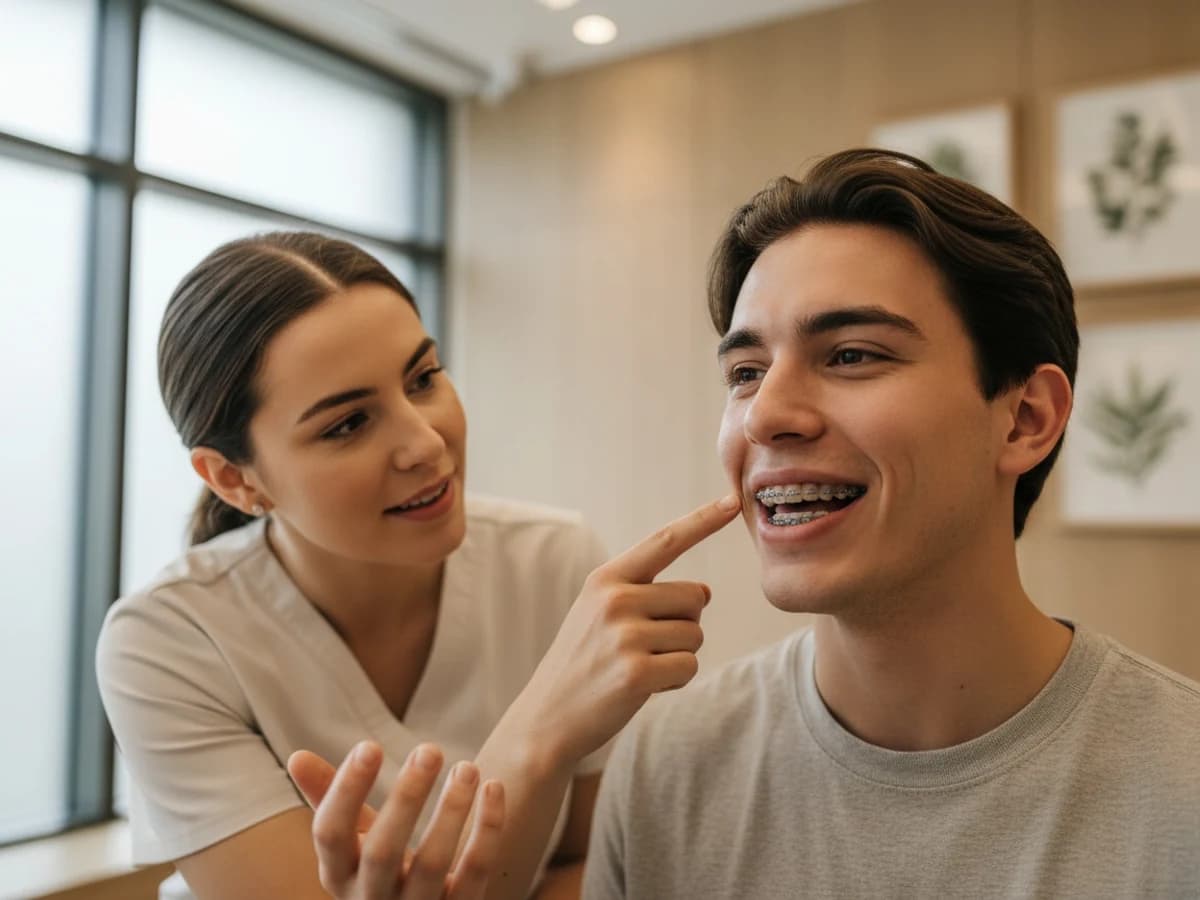
Can orthodontic braces change the way you speak?
Short answer: yes, but usually only temporarily. Many patients notice subtle changes in articulation after fixed braces or other orthodontic appliances are placed. These changes tend to be most obvious on sounds that require precise tongue-to-tooth contact, such as the /s/ sound and other sibilants, as well as certain stopped consonants. For most people this is an adjustment-phase effect that improves with practice and time.
Why braces can affect speech
Orthodontic appliances alter the physical space in your mouth. Fixed labial braces (the common brackets bonded to the front of the teeth) add small amounts of bulk along the tooth surface and can change where the tongue and lips naturally rest. That can slightly alter airflow and the contact points your tongue uses to form specific sounds. Lingual braces, which are bonded to the tongue-side of teeth, sit even closer to the tongue and are therefore more likely to affect speech initially. Clear aligners can also change sound production, but because they are removable some patients find the impact easier to manage during the adaptation phase.
Which sounds are most likely to change?
- /s/ and other sibilants: these are commonly reported as the most affected because they need a narrow channel of air over the tongue and teeth.
- Stopped sounds: such as /t/ and /d/ may be slightly altered when tongue contact areas shift.
- Subtle changes: vowels are usually less affected, but rapid speech and consonant clusters can temporarily sound different.
Typical timeline: what to expect
Patients commonly notice a speech change right after appliance placement. Many adapt rapidly: a significant number report clear improvement within a few weeks to about two months. Clinical observations show that while a portion of patients have measurable changes soon after insertion, a large proportion adapt within the first two months. In most cases, any acquired speech errors resolve some time after treatment is finished and appliances are removed. A smaller subset may need longer adaptation or additional support.
Practical steps to adapt faster
Speech adaptation is largely practice-based. Below are simple, practical exercises and daily habits that help retrain tongue and lip movements:
- Slow, deliberate repetition: Say difficult words or sounds slowly 10–20 times, focusing on correct tongue placement. Repeat several times daily.
- Reading aloud: Read a short paragraph out loud for 5–10 minutes a day, paying attention to clarity rather than speed.
- Minimal-pair drills: Practice word pairs that differ only in the sound you find difficult (for example, “sip/ship” or “see/sea”) to heighten awareness and control.
- Mirror and tactile feedback: Use a mirror to watch lip posture and, gently, a clean finger to feel where the tongue touches when producing certain sounds—this helps re-establish correct contact points.
- Short frequent sessions: Ten-minute practice sessions multiple times per day are more effective than a single long session.
- Use recordings: Record yourself reading and compare over time to track improvement; hearing yourself can accelerate progress.
When to seek professional help
If speech problems persist beyond the expected adaptation window (for example, several months after placement) or if you had pre-existing articulation concerns, consider a referral to a speech-language pathologist. In some cases, coordinated care between the orthodontist and a speech-language therapist accelerates recovery and addresses any combined structural and learned components of the speech difficulty. Also check with your orthodontist if you experience persistent discomfort, ulcers, or appliance breakage that interferes with normal tongue function.
How appliance choice and modern techniques help
When planning treatment, orthodontists take speech impact into account. Appliance options and design features can reduce interference: low‑profile brackets, careful bracket placement, and well-contoured archwires minimize bulk. Digital scanning and 3D planning let clinicians visualize how appliances will sit in the mouth and can be useful for tailoring treatment to patients with high speech demands (for example, teachers or singers). For complex skeletal or dental relationships, CBCT and comprehensive diagnostics can guide treatment so both function and aesthetics improve—often improving speech in the long term once alignment is corrected.
Long-term outlook: braces can help as well as hinder
While appliances may cause a temporary lisp or altered sounds during the adjustment period, properly planned orthodontic treatment often improves speech in the long run. Many speech problems are rooted in crowding, open bite, or other malocclusions that interfere with normal tongue posture. Correcting those structural problems can restore more natural articulation once treatment is complete.
Support at Dentsun International in Antalya
At Dentsun International Dental Center we understand how important clear speech is for daily life and confidence. Our team discusses potential speech effects during treatment planning and uses modern digital tools to design appliances that balance effectiveness with comfort. If needed, we coordinate with speech-language specialists to provide a combined care plan. Antalya is a convenient destination for international patients seeking high-quality orthodontic care with experienced clinicians and modern facilities, and many visitors appreciate combining treatment with the ease of travel and local hospitality.
Final reassurance
Feeling anxious about a temporary lisp or pronunciation changes is normal, but most patients adapt well within weeks to a few months. Simple, focused exercises and open communication with your orthodontist will usually resolve the issue. If you’re considering orthodontic care and speech is a concern, bring it up at your consultation—your clinician can explain appliance options, expected timelines, and supportive strategies to keep your speech clear throughout treatment.


